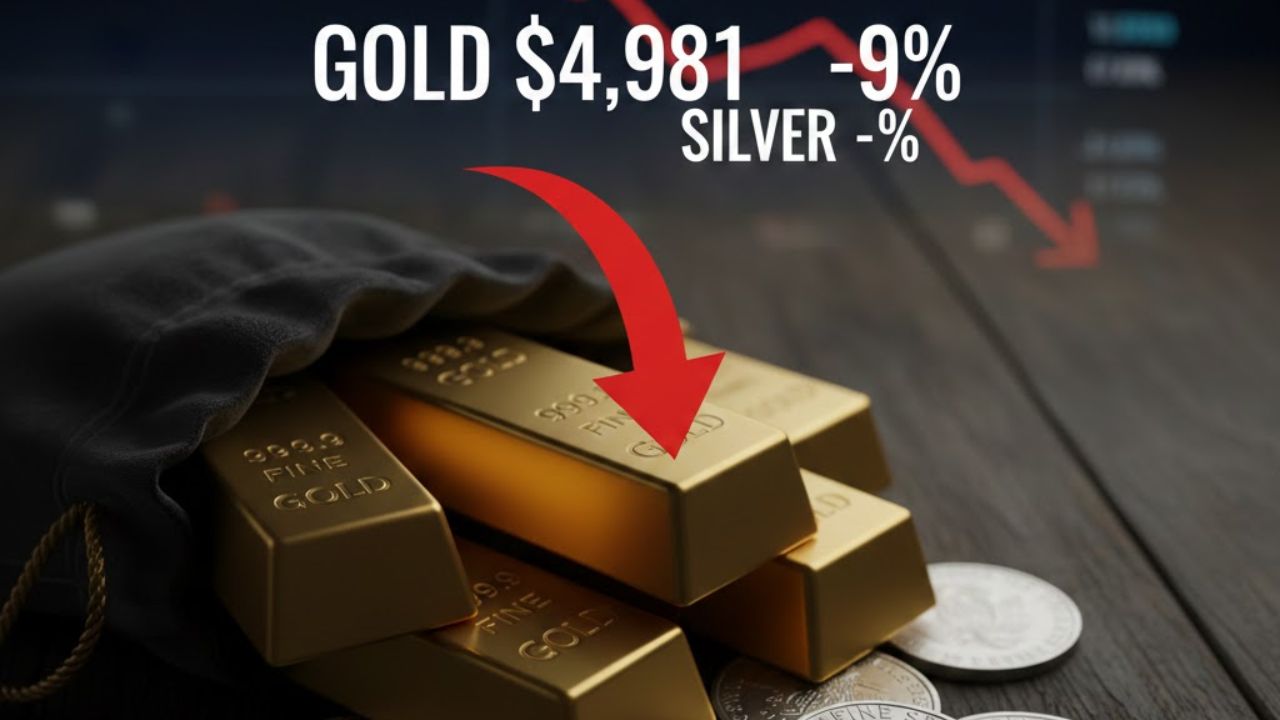
The precious metals market is currently undergoing a significant period of adjustment. As of February 13, 2026, investors are witnessing a sharp downturn that has caught many by surprise. Gold has recently slipped to $4,981 per ounce, while silver has faced a more aggressive sell-off, sliding nearly 9% in recent sessions. This volatility follows a historic bull run where both metals reached record peaks earlier in the year. To understand why these “safe-haven” assets are losing ground, we must look at a combination of robust economic data, a strengthening dollar, and technical market triggers that have forced many traders to liquidate their positions.
The Impact of Strong US Labor Data
The primary catalyst for the current slump is the surprisingly resilient US economy. On February 12, 2026, the US labor market reported adding 130,000 nonfarm payroll jobs in January, significantly exceeding the forecast of 70,000. Additionally, the unemployment rate dipped to 4.3%. For gold and silver, “good news” for the economy is often “bad news” for prices. This strong data has led the Federal Reserve to reconsider its stance on interest rate cuts. Previously, markets had priced in a high probability of a rate cut in March; however, that expectation has now collapsed to roughly 8%. Since gold and silver do not provide interest or dividends, they become less attractive when interest rates remain “higher for longer.”
Strengthening of the US Dollar and Yields
As expectations for a Federal Reserve pivot faded, the US Dollar Index (DXY) staged a powerful comeback, rebounding toward the 97-98 range. Because precious metals are priced in dollars globally, a stronger greenback makes gold and silver more expensive for international buyers, naturally dampening demand. Simultaneously, US Treasury yields have climbed. When investors can earn a guaranteed return on government bonds, the opportunity cost of holding non-yielding assets like gold increases. This “double pressure” effect—a rising dollar and higher bond yields—has been a major driver in pushing gold below the psychological $5,000 support level.
Technical Breakdown and Margin Calls
From a technical perspective, the price drop was accelerated by automated trading. Gold had been consolidating in a tight band between $5,000 and $5,100 for several days. Once the price broke below $5,000, it triggered a wave of stop-loss orders. Silver, which is historically more volatile and often more leveraged, suffered even more. As silver prices plummeted toward $75, many traders faced “margin calls,” requiring them to sell their holdings immediately to cover potential losses. This created a cascading effect, where selling led to further price drops, which in turn triggered more selling—a classic “mechanical” market correction.
Comparative Market Data: Gold vs. Silver (Feb 2026)
| Asset Type | Current Price (Approx.) | Recent % Change | 52-Week High | Key Support Level |
| Gold (Spot) | $4,981 / oz | -2.3% to -4% | $5,626 | $4,900 |
| Silver (Spot) | $75.78 / oz | -8.8% to -11% | $122 | $74.00 |
| MCX Gold (India) | ₹1,55,780 / 10g | -1.7% | ₹1,93,096 | ₹1,50,000 |
| MCX Silver (India) | ₹2,70,900 / kg | -3.7% | ₹4,20,048 | ₹2,50,000 |
Profit Booking and the “Trump Effect”
Another factor contributing to the decline is simple profit-taking. Over the past year, gold and silver have seen astronomical gains of 40% and 160% respectively. Many institutional investors are now locking in those gains to balance their portfolios. Furthermore, political shifts in the US, including President Trump’s nomination of Kevin Warsh—viewed by many as a “hawk” on inflation—to the Federal Reserve, have reinforced the idea that the era of “easy money” and aggressive rate cuts may be over. The prospect of a more stable geopolitical environment and potential trade deals has also reduced the “fear premium” that usually keeps gold prices elevated.
Domestic Factors in the Indian Market
In India, the situation has been further complicated by the recent Union Budget 2026. Speculation regarding a potential cut in basic customs duty on bullion led many domestic traders to hold off on purchases or sell existing stock. While the global market sets the benchmark, the local price on the Multi Commodity Exchange (MCX) reacted sharply to these domestic policy cues. The combination of global dollar strength and local regulatory uncertainty caused Indian gold and silver prices to hit “lower circuit” levels earlier in February, marking one of the most volatile periods in the history of the Indian bullion trade.
Future Outlook and Investment Strategy
Despite the current carnage, many analysts remain bullish on the long-term prospects of precious metals. The underlying drivers—such as high global debt levels, central bank diversification away from the dollar, and the industrial demand for silver in green energy—remain intact. Some experts predict that gold could still reach $6,000 by the end of 2026 if inflation remains sticky or if geopolitical tensions resurface. For now, the market is in a “wait-and-see” mode, with investors closely watching upcoming US Consumer Price Index (CPI) data. If inflation cools more than expected, it could breathe new life into the metals; if not, further testing of support levels is likely.
FAQs
Q1. Is this the end of the bull market for gold and silver?
Most analysts view this as a healthy correction after a “parabolic” move. While short-term volatility is high, the long-term structural demand from central banks and industrial sectors (for silver) suggests the broader uptrend may still be intact.
Q2. Why did silver fall more than gold?
Silver is both an investment asset and an industrial metal. It is also a smaller, less liquid market than gold, making it prone to wider price swings. High levels of leverage in silver futures often lead to more aggressive sell-offs during market corrections.
Q3. What should investors do during this price drop?
Financial experts generally advise against emotional selling. Many suggest using significant dips as a “buying opportunity” for long-term positioning, provided the investor has set appropriate stop-loss orders to manage risk.
Disclaimer
The content is intended for informational purposes only. You can check the official sources; our aim is to provide accurate information to all users.